



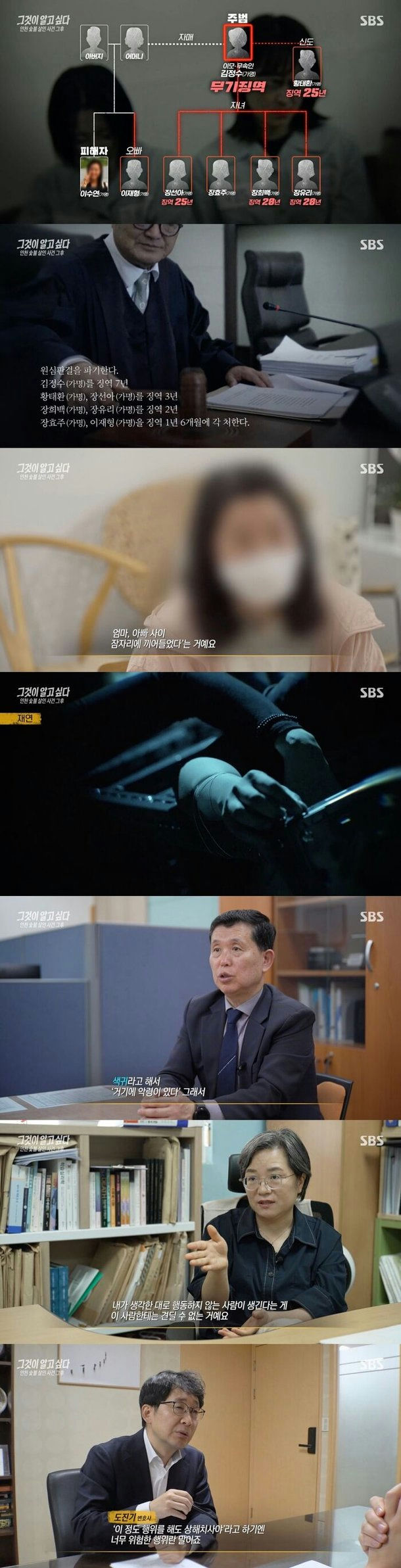
The May 30 episode of SBS’s Unanswered Questions examined the controversial reversal of a ruling in the infamous charcoal exorcism death case.
On September 18, 2024, a gruesome death occurred at a restaurant in Incheon. A group of perpetrators tied a woman in her 30s to a steel frame structure and lit charcoal briquettes beneath her, ultimately causing her death.
What made the case even more shocking was the fact that the perpetrators were members of the victim’s own family, including her aunt, identified as Kim, and Kim’s children.
Kim, who worked as a shaman, carried out what she described as an exorcism ritual alongside her children and followers. During the ritual, the victim suffered severe third-degree burns covering approximately 25 percent of her body and later died from her injuries.
In the first trial, the court sentenced Kim to life imprisonment and handed prison terms of more than 20 years to her accomplices. The victim’s biological brother, who knew about the plan but failed to intervene, was sentenced to 10 years in prison for aiding and abetting the crime.
However, a dramatic reversal occurred during the appeals trial in April. The court changed the charge from murder to fatal bodily injury, reducing Kim’s sentence to seven years. The appeals court ruled that the perpetrators had neither intended nor planned to kill the victim and could not have foreseen her death. The decision sparked public outrage, particularly because six accomplices received suspended sentences.
During the trial, Kim claimed that the victim had been possessed by evil spirits since the second grade of elementary school and insisted that the ritual was conducted to save her. Kim further alleged that the victim had been romantically involved with her father and brother in a previous life and had even carried a knife with the intention of killing her mother. Based on these beliefs, Kim proposed the charcoal exorcism ritual, and the victim allegedly agreed to participate voluntarily. The appeals court paid particular attention to this argument.
The first court found that the crime exceeded any ordinary act of harm once the victim began begging to be released from her restraints but was ignored. According to the ruling, the perpetrators even placed burning charcoal in her mouth and gagged her. However, the appeals court concluded that the situation was not critically dangerous during the first one hour and eleven minutes of the ritual.
Kim reportedly grabbed the victim by the hair, slapped her repeatedly, and moved the charcoal brazier closer to her body. The victim was later stripped naked and directly exposed to the heat. Despite her desperate cries of pain, none of those present attempted to rescue her.
The perpetrators also claimed that the victim was possessed by a lustful spirit and directed intense heat toward her genital area. The ritual continued for two hours and fifty-one minutes before finally being stopped. After lowering the victim from the frame, the group poured cold water on her and attempted artificial respiration and CPR but never called emergency services.
Instead, they spent nearly two hours dismantling the steel structure and cleaning the scene. The first court viewed these actions as evidence of an attempt to conceal the crime, supporting the murder conviction. However, the appeals court ruled that the delayed emergency report alone was insufficient to prove intent to kill or a conspiracy to commit murder. It also concluded that false statements about how the burns occurred could have been made out of panic.
The first court also relied on testimony from the victim’s brother and cousin, who stated that the perpetrators were aware of the dangers involved. The appeals court disagreed, ruling that awareness of risk did not necessarily prove a plan to kill and that it remained difficult to conclude the perpetrators foresaw the victim’s death.
One expert interviewed on the program argued that the key difference between the two rulings lay in how Kim was perceived. “The first court viewed Kim as a malicious individual, while the appeals court believed she genuinely cared for her niece and was performing the ritual for her benefit,” the expert explained.
Another expert criticized the appeals ruling for dismissing much of the first court’s reasoning. “The lower court considered financial motives as part of the murder motive, but the appeals court rejected that conclusion,” the expert said. While the appeals court determined that Kim herself was not experiencing financial difficulties, many of her accomplices reportedly had significant debt and were struggling economically. The expert suggested that their financial circumstances may have resulted from manipulation or exploitation.
Evidence presented on the program indicated that Kim’s children and followers had been under considerable pressure while helping repay her debts.

The production team also conducted an experiment to determine whether the perpetrators could have recognized the danger of their actions. A physician who reviewed the circumstances stated, “Anyone present at the scene would have understood the risks. From a medical perspective, it was clearly an environment capable of causing death.”
A legal expert, however, argued that it may have been difficult for ordinary people to fully understand the severity of the heat, noting that it would not necessarily have been obvious that the steel frame had become too hot to touch.
The program further examined Kim’s background. According to those interviewed, she reportedly changed dramatically after undergoing a spiritual initiation following marriage. Family members allegedly became little more than extensions of her will, while Kim continuously exploited her children. Some of them reportedly attempted to escape from her influence.
A behavioral expert described Kim as someone who viewed herself as all-powerful. “She appears to have no fear and no sense of guilt,” the expert said. “The financial motives are hidden beneath the surface. She likely could not tolerate someone refusing to act according to her wishes. That would have severely damaged her self-esteem.”
The expert added that punishing the victim may have been necessary in Kim’s mind because allowing resistance could encourage others to stop obeying her authority.
The same expert suggested that while Kim may not have begun the ritual with a specific intention to kill, the intense anger driving the act could have escalated throughout the ordeal.
Another expert questioned the appeals court’s decision to divide the crime into three separate stages, arguing that at some point during the ritual the perpetrators must have developed at least conditional intent to kill. The expert said it was difficult to understand why the original murder conviction had been overturned.
A separate specialist also criticized the ruling, warning that classifying such extreme conduct as fatal bodily injury rather than murder could set a dangerous precedent.
The case has now moved to South Korea’s Supreme Court. Seeking answers from all sides, the Unanswered Questions production team attempted to speak with the victim’s parents. However, the parents remained wary of the media and declined to participate in interviews, leaving several questions unanswered.
Sources: Nate