



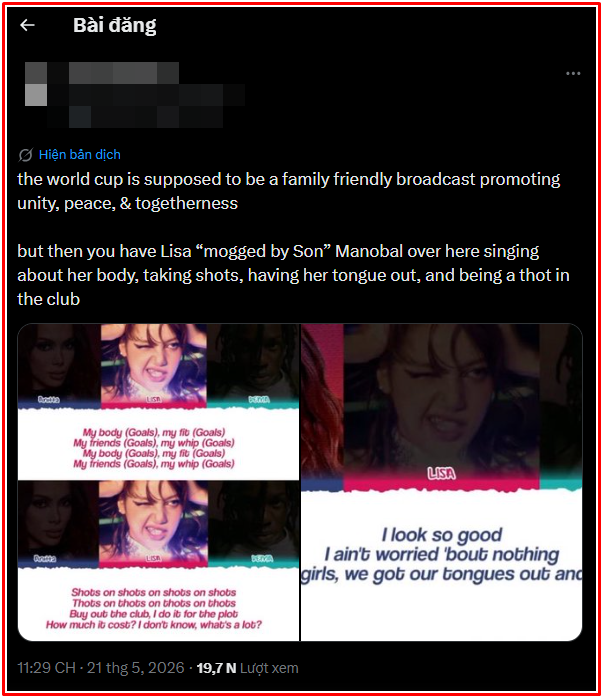
Lisa officially stepped onto the global football stage after participating in the official FIFA World Cup 2026 anthem “Goals”, alongside Anitta and Rema. However, despite massive anticipation surrounding the release, the song has quickly become the center of heated online debate.

Ahead of the tournament, FIFA introduced “Goals” as the official soundtrack meant to energize football fans worldwide. With Lisa’s international popularity combined with Latin and Afrobeats influences from Anitta and Rema, many expected the track to dominate streaming platforms and social media trends.

Instead, the reaction has been sharply divided.

While some listeners praised the song’s energetic production and festival-like atmosphere, many others criticized the track for lacking emotional depth and failing to capture the unifying spirit traditionally associated with World Cup anthems.

Several online comments described “Goals” as sounding more like a commercial advertising campaign than a memorable football anthem. Critics particularly targeted the lyrics, arguing that the song felt superficial and failed to create a sense of connection between cultures and nations. Some even labeled the track “embarrassing” compared to iconic World Cup songs from previous tournaments.

As criticism spread, many netizens began comparing “Goals” to “Dreamers”, the official FIFA World Cup 2022 song performed by Jungkook.
Released during the Qatar World Cup, “Dreamers” received widespread praise for its inspirational message, uplifting melody, and Jungkook’s live performance during the tournament’s opening ceremony. For many fans, the song better represented the emotional core of the World Cup: unity, hope, and global connection.
The comparisons have inevitably placed even more pressure on Lisa, especially since this marks one of the few times a BLACKPINK member has participated in a project tied directly to a major global sporting event.
Still, some fans defended Lisa amid the backlash, pointing out that artists involved in official FIFA songs rarely have full creative control over the music, lyrics, or overall direction of the project. Many argued that commercial strategy and FIFA’s global branding likely played a significant role in shaping the final product.
The controversy surrounding “Goals” once again highlights the enormous expectations attached to World Cup songs. Audiences no longer simply want a catchy tune — they expect an anthem capable of becoming part of football history and creating emotional memories for billions of fans worldwide.
Despite the mixed reception, Lisa’s participation in the FIFA World Cup 2026 project remains a major milestone in her international career. However, the ongoing debate suggests that star power alone may not be enough to turn a sports anthem into a true cultural phenomenon.