



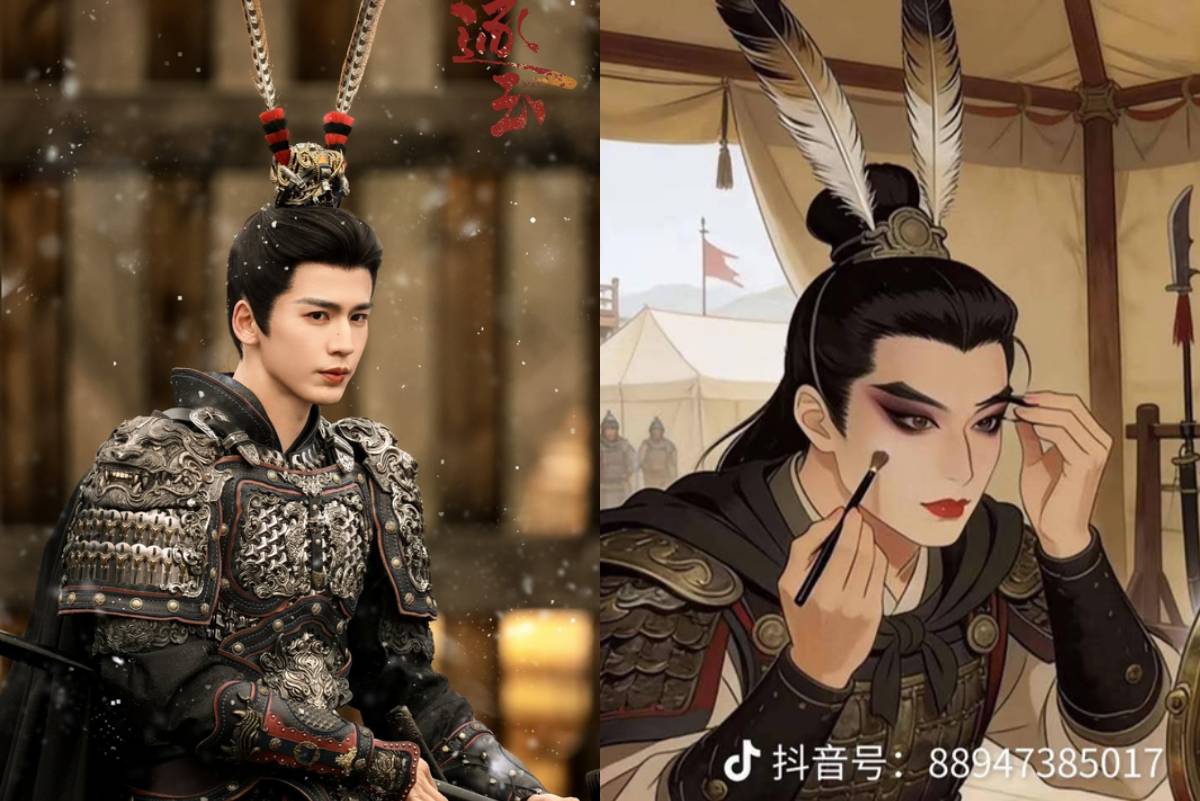
Zhu Yu has recently become one of the hottest historical dramas in China, boosting the popularity of its leads Zhang Linghe and Tian Xiwei. However, alongside its rising viewership, the drama is now facing growing controversy over its portrayal of realism—particularly surrounding Zhang Linghe’s character.
In the series, Zhang Linghe plays the general Wu An Hou, a battle-hardened military figure. Yet, viewers quickly pointed out that the character appears on the battlefield with flawless makeup, leading netizens to mockingly him the “foundation general.” The criticism soon escalated beyond online discussions, with Chinese military-affiliated media outlet “Jun Zhengping” publicly questioning the portrayal, arguing that it deviates from basic historical and realistic expectations.

The debate didn’t stop there. China’s major state newspaper People’s Daily published a commentary analyzing the broader issue, suggesting that such portrayals reflect a deeper problem within the costume idol drama genre—what experts describe as a growing “hollowing out” or lack of substance.
According to academic Bian Yunlu from Shandong Normal University, many recent costume idol dramas appear diverse on the surface but are often criticized for feeling repetitive and “pre-packaged.” She argues that this trend is not simply due to creative laziness, but rather the result of increasing commercial pressure and the industry’s reliance on proven formulas.
To replicate past successes, production teams frequently reuse familiar tropes, emotional beats, and character dynamics from hit dramas. However, this approach often fails to resonate with modern audiences whose expectations have evolved, resulting in content that feels disconnected despite its polished appearance.

Visual presentation has also come under scrutiny. While many productions invest heavily in highly refined aesthetics—from makeup and costumes to filters and cinematography—critics argue that narrative coherence and realism are often sacrificed. The result is a series of visually striking scenes that fail to form a convincing or immersive story world.
Casting trends further highlight the issue. The so-called “pre-packaged” model extends to actor selection, where young popular stars are frequently paired in predictable combinations. This pattern is largely driven by fan economy dynamics, as these actors bring built-in audiences that directly influence viewership metrics, online buzz, and platform performance.
However, this system also shifts focus away from storytelling. Fans tend to prioritize visuals, on-screen chemistry, and aesthetic appeal over narrative depth, reinforcing a cycle where producers favor safe, commercially viable formulas over creative risks.
While this approach may generate short-term success, experts warn that it could ultimately limit innovation and alienate audiences. As the controversy surrounding Zhu Yu continues, it has reignited discussions about the future of costume dramas—and whether the industry can break free from its increasingly “hollow” formula.
Sources: China Times,People’s Daily