



Avatar: Fire and Ash has become one of the most talked-about blockbusters of the year, drawing mixed reactions from critics despite strong audience approval. While some reviewers argue that the film lacks narrative innovation, many viewers continue to praise its breathtaking visuals and immersive cinematic experience.
At a time when audiences are increasingly fatigued by Hollywood’s reliance on sequels and spin-offs designed to endlessly capitalize on successful franchises, Avatar remains a rare exception that still generates genuine anticipation. Each new installment feels like a major cinematic event, eagerly awaited by both moviegoers and critics alike. However, unlike the first two films—which were widely celebrated as high-quality works and even regarded as modern cinematic landmarks—the third entry has proven far more polarizing.
On Rotten Tomatoes, Avatar: Fire and Ash holds a strong 91% audience score, while critics rate it significantly lower at 66%, marking a noticeable decline compared to its predecessors. A similar trend appears on Metacritic, where the film sits at 61 out of 100—respectable, but far from outstanding for a franchise of this stature.
The film runs for three hours and 17 minutes and picks up immediately after the devastating battle depicted in The Way of Water. Jake Sully’s family is still reeling from the loss of their eldest son, yet they are forced to regroup quickly as humanity prepares for another aggressive campaign on Pandora. This time, the planet faces an even greater threat with the emergence of the Ash clan, a brutal Na’vi tribe that glorifies violence and plunder. Their alliance with Colonel Miles Quaritch forms a dangerous opposing force that directly endangers Jake’s family and the Na’vi people as a whole.

Visually and in terms of world-building, James Cameron’s mastery remains largely unquestioned. In earlier installments especially The Way of Water the director used quieter moments between battles to expand Pandora, introducing new regions, ecosystems, and cultures. These elements gave the films a strong sense of discovery and helped audiences believe in the existence of a vast, living alien world.
Naturally, expectations were high when Fire and Ash introduced a new elemental theme centered on fire and unveiled the Ash clan. Many viewers hoped to explore fresh cultural dimensions and environments tied to this concept. However, some international critics argue that the world-building does not expand as meaningfully as anticipated. Despite introducing two new clans the Ash and the Wind clan the film does not delve deeply into their cultures or daily lives. Large-scale battles often unfold in familiar settings, and the creature designs feel similar to those seen in previous films, resulting in moments that feel repetitive rather than groundbreaking.
This shortcoming may partly stem from the film’s development history. James Cameron previously revealed that Avatar 2 and Avatar 3 were initially conceived as a single film, later split due to the sheer volume of ideas and content. As a result, Fire and Ash can feel less like a standalone story and more like an extended continuation.
Critics have also pointed out that the narrative does not fully justify its lengthy runtime. At over three hours the longest installment in the franchise the film revisits familiar themes such as human invasion, the intervention of massive creatures, and Eywa’s role in the conflict. These recurring motifs make the story feel predictable, and the lack of a clearly distinct storyline leaves some viewers feeling fatigued.

Additionally, the screenplay has been criticized for juggling too many plotlines without giving them sufficient depth. From the lingering grief and desire for revenge within Jake Sully’s family, to Spider’s struggle to find his place as a human among the Na’vi, to broader ecological themes, multiple threads are introduced only to be quickly sidelined or resolved hastily. Ultimately, the film culminates in a large-scale battle whose setup and execution closely resemble those of The Way of Water.
Despite these criticisms, Avatar: Fire and Ash still holds undeniable appeal. The franchise has never been known for complex storytelling; instead, its strength lies in Cameron’s extraordinary imagination and his ability to construct a fully realized alien ecosystem, complete with flora, fauna, languages, and cultures. The true power of Avatar lies in its visual spectacle and its ability to immerse audiences in a fantastical world.
In the third installment, Cameron doubles down on this strength. Pandora is presented with even greater visual ambition than before, featuring sweeping, visually rich sequences that elevate the sense of scale. From ethereal balloon-like vessels floating through the skies to breathtaking aerial battles, the film delivers a sensory experience few blockbusters can rival.
Viewed together, The Way of Water and Fire and Ash function more cohesively as a single narrative. The former focuses on world-building and emotional groundwork, while the latter accelerates the pace and embraces a darker, more violent tone. The conflicts escalate rapidly, stacking tension upon tension and driving the story toward the conclusion of humanity’s second major invasion of Pandora.

While Avatar 3 may not offer significant narrative breakthroughs, it remains faithful to the franchise’s core themes family, love, environmental balance, and war. Its straightforward storytelling allows emotional beats to land gently, leaving room for spectacular action and cutting-edge visual effects to take center stage, delivering a form of pure cinematic escapism.
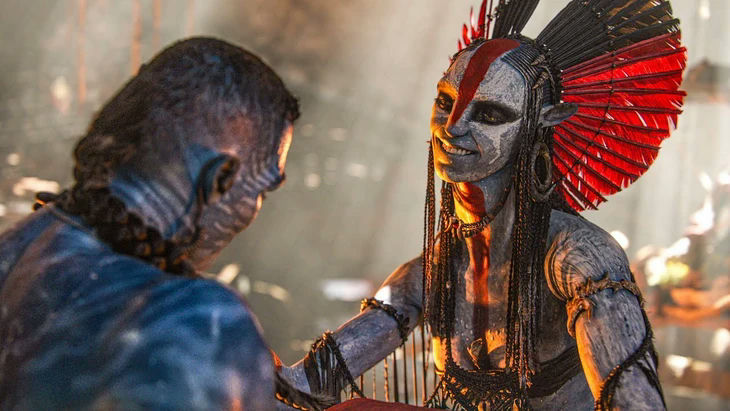
Another area where the film succeeds is in its villains. Miles Quaritch, once a commanding symbol of human authority, has gradually lost some of his menace across the series. In contrast, Varang, the fierce leader of the Ash clan, emerges as a genuinely terrifying new antagonist ruthless, primal, and bloodthirsty. Her alliance with Quaritch raises the stakes significantly, intensifying the sense of danger and fueling the film’s most gripping action sequences.
Supporting characters are also given more room to grow, setting the stage for future installments. Lo’ak shows clear maturity following his brother’s death, becoming more responsible and self-aware. Neytiri, meanwhile, is portrayed with greater psychological depth: blinded by hatred at the film’s start, she gradually learns to let go, ultimately accepting Spider and finding closure after a deeply painful emotional journey.
Ultimately, Avatar remains a mainstream action-adventure sci-fi franchise, and Fire and Ash fulfills that role effectively. Compared to other long-running blockbusters like Fast & Furious, Transformers, or Pirates of the Caribbean, the series has maintained a consistent identity and sense of purpose. James Cameron has largely avoided turning Avatar into a hollow cash grab, and the franchise continues to show strong potential for meaningful expansion in future chapters.
Sources: Znews