



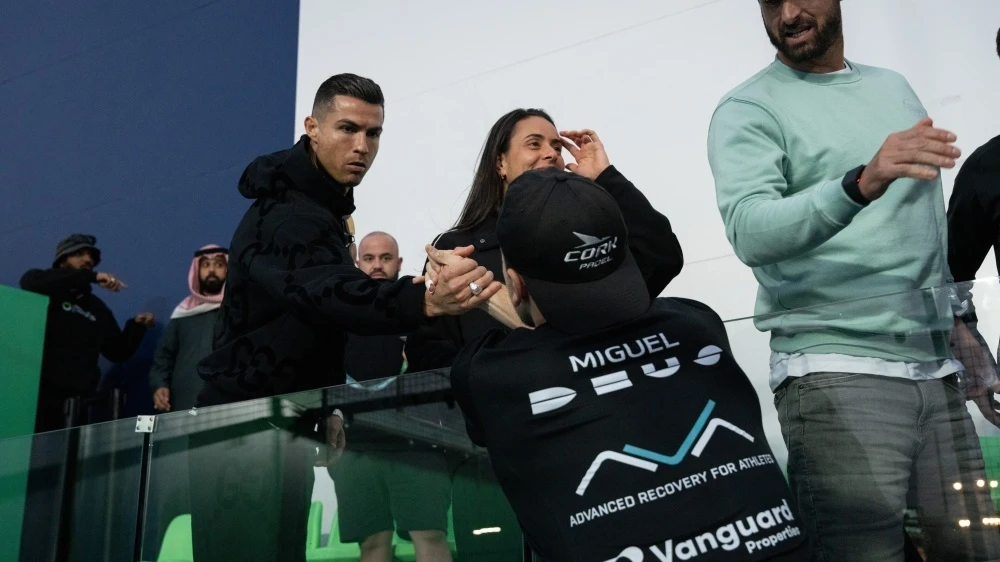
Cristiano Ronaldo did not arrive at Al Nassr merely to play football. His presence was meant to elevate the image, prestige, and global visibility of the Saudi Pro League itself.
The contract extension he signed last July, running through 2027 and reportedly earning him close to £488,000 per day, placed Ronaldo in a position unprecedented in Saudi football history. No other player combines elite sporting value with the symbolic role of representing a national soft-power strategy on such a scale. He is not just a footballer; he is a project.
Image or Symbol?
Ronaldo is far more than Al Nassr’s striker. He appears at high-level diplomatic events, meets political leaders, and engages with some of the most powerful business figures in the world.
When he declared, “I belong to Saudi Arabia,” it was not a casual remark. It was a statement of identity and position. Ronaldo has embraced a role in which he is not merely an employee of wealthy club owners, but a central figure in a broader national narrative.
And because he has been given so much, his expectations have grown accordingly. Ronaldo believes Al Nassr should be invested in proportion to his stature. He believes the club that bears his name in the global spotlight should stand level with—if not above—Al Hilal.
When the January transfer window closed quietly, that sense of being sidelined began to take hold.

The Trigger Point
At the same time, Al Hilal—Al Nassr’s direct rival and also under the control of Saudi Arabia’s Public Investment Fund (PIF)—completed the signing of Karim Benzema from Al Ittihad.
The contrast was striking. And for a player accustomed to standing at the center of power, it was enough to provoke a reaction.
According to A Bola, Ronaldo refused to play in the February 2 match against Al Riyadh in protest against the transfer policy. Notably, Benzema himself had previously staged a similar “strike” to force a move.
Two global superstars. Two acts of defiance. One ownership system. Yet it is precisely here that the limits of individual power become visible.
Right in Principle, Isolated in Practice
From a sporting perspective, Ronaldo’s argument is not without merit. He remains the focal point of Al Nassr’s attack, continues to score goals, and maintains elite performance levels at the age of 40.
But football is not a solo performance. A squad lacking depth cannot sustain a long title race. The gap between Ronaldo’s personal assessment and the league’s overarching strategy has begun to widen.
What he sees as a footballing necessity clashes with a centrally managed vision that prioritizes balance, optics, and long-term planning over individual demands.
When Discipline Confronts Discipline
In European football, Ronaldo’s reaction would feel familiar. There, stars of sufficient stature can pressure clubs into action.
The Saudi Pro League, however, does not operate on that logic. It is a top-down system. Power does not reside in the dressing room but at the strategic level. The PIF did not build this league around one man—even if that man is Cristiano Ronaldo.
This paradox leaves Ronaldo out of sync. He is celebrated like a king, yet has never truly sat on the throne.
Saudi Arabia’s massive football investment has created an environment where aging superstars earn enormous wages and wield immense image power, but remain fundamentally dependent on state authority. They are indulged—but only within clearly defined limits.

Hitting the Power Ceiling
Ronaldo built his legacy on absolute professionalism. Stories of relentless training routines, wherever he played, defined a man obsessed with winning. Thousands of hours of discipline created Cristiano Ronaldo.
Now, that same figure—synonymous with order and control—has chosen to defy discipline, voicing frustration in a system where power surrounds him from every direction. His refusal to play was not just a transfer protest; it was a collision with his own power ceiling.
This is no longer simply about football, nor about signings. The tension may ease, or it may not. But the moment Ronaldo stayed off the pitch revealed an uncomfortable truth: in the desert of power, he is not the one moving the pieces on the board.
The unanswered question remains whether the stars brought in to elevate the league will accept the role of pieces within a pre-designed order—or continue to clash with a structure that was drawn long before they arrived.
Sources: Znews