



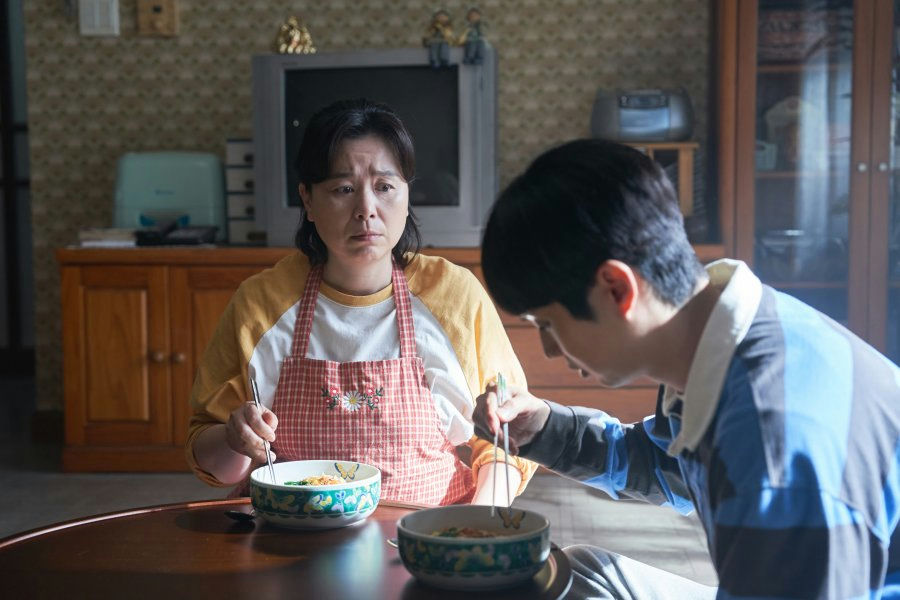
Number One has drawn early attention precisely because it brings back the duo whose on-screen relationship left a strong impression in Parasite, which won four Academy Awards. This time, however, they explore a very different emotional landscape, centered on quiet moments, family bonds, and the inescapable passage of time.
Number One is adapted from a well-known Japanese short story and focuses on ordinary, intimate moments where time is no longer invisible but becomes something tangible something that can be counted down. The story follows Ha-min, played by Choi Woo-shik, a son who discovers a strange phenomenon: every time he eats food cooked by his mother, Eun-sil (played by Jang Hye-jin), he sees a number that steadily decreases. When the number reaches zero, his mother will pass away.

This devastating realization forces Ha-min into a painful paradox. In order to keep his mother alive for as long as possible, he must distance himself from her avoiding her meals, her care, and even her love. From the familiar and seemingly safe space of the family dining table, the film unfolds into a poignant meditation on loss, maternal love, and the inevitability of separation. It quietly poses a haunting question: if we knew exactly how much time we had left with those we love, would we live differently, or would we still let precious moments slip away unnoticed?
Director Kim Tae-yong, speaking about reuniting the Parasite mother-and-son pairing, emphasized that although the relationship remains the same on the surface, the emotional tone of Number One is entirely different. Choi Woo-shik portrays Ha-min with restrained, introspective acting, capturing the internal conflict between love and fear of loss. Jang Hye-jin delivers a warm, understated performance as a mother who gradually senses her son growing distant, without knowing the heartbreaking reason why.

The film also marks Kim Tae-yong’s return after a long hiatus. Known for transforming personal experiences into delicate cinematic language, he previously gained international recognition at the Cannes Film Festival with the short film Frozen Land, and later solidified his reputation through works such as Set Me Free and Misbehavior. For this project, Kim shared that the film is not merely a family story but also a deeply personal journey—one in which he felt he was “building a family” during the filmmaking process, drawing inspiration from memories of his own mother and the irreplaceable comfort of home-cooked meals.
Sources: VTV