




“Perhaps, in the end, life is a journey of learning how to let go. But what hurts us the most is not having even a single moment to say goodbye.”
These poignant words from Life of Pi are spoken as the main character, Pi Patel, recalls his farewell to Richard Parker, the Bengal tiger who accompanied him on an extraordinary journey across the Pacific Ocean. After surviving countless dangers and fighting side by side for their lives, Richard Parker eventually walks into the jungle and disappears without looking back. There are no words of farewell, no final moment to bring closure to the journey they shared.
Perhaps what hurt Pi the most was not Richard Parker’s departure itself. After everything they had been through, their separation was ultimately inevitable. What was heartbreaking was that they never even had the chance to say goodbye.
Fans of Cristiano Ronaldo in the Portugal national team shirt may have experienced a similar sense of sadness when they saw his farewell announcement on social media. Few could have imagined that the match against Wales on September 24 in Lisbon would be Ronaldo’s final appearance for Portugal, even though everyone understood that, at 41, his time at the highest level was running out.

There would be no perfect ending, no fairytale “Last Dance” crowned by winning the 2026 World Cup on American soil. Comparing his farewell with that of Lionel Messi, Ronaldo’s great rival for more than two decades, makes the contrast even more striking. Messi enjoyed an outstanding individual World Cup campaign and received a grand farewell in his homeland of Argentina, surrounded by smiles, tears, and teammates who had helped him win the 2022 World Cup. More importantly, everyone knew that the end was approaching. Ronaldo, by contrast, was left applauding sadly before walking off the pitch in Lisbon, without such a farewell.
At the time, perhaps even Ronaldo himself could not have anticipated the events that would follow: an irreparable conflict with coach Jorge Jesus, a controversy surrounding his premature departure from the national team setup, and a series of subsequent statements and heated debates on social media. When the Portuguese Football Federation announced a relatively light disciplinary punishment for Ronaldo in October, many believed he would return to the national team for the November international break. Ultimately, however, that reunion never happened.
After 23 years, Portugal’s iconic No. 7 shirt will no longer be worn by Cristiano Ronaldo. A journey that began with enormous expectations and reached heights few could have imagined has ended with an unexpected farewell away from the pitch.
Perhaps precisely because the ending was so incomplete, it is all the more important to look back at Ronaldo’s entire journey with Portugal rather than allow the controversies surrounding his final chapter to define his legacy.
What Remains Beyond the Goals, Records, and Trophies
“234 appearances. 146 goals. Six World Cups. Six European Championships. Three official titles. The greatest goalscorer in the history of the national team.” Ronaldo could easily have opened his farewell video on social media with those words, or included them somewhere in his message, as he brought his 23-year Portugal career to a close. After all, he has every right to take pride in what he contributed to the national team.

Instead, he chose to focus on the iconic shirt: “The day has come for me to return Portugal’s No. 7 shirt. I never felt that the shirt belonged exclusively to me. But for 23 years, I had the privilege and responsibility of wearing it, defending it, and taking it to stadiums around the world.”
The shirt became so closely associated with his name that generations of fans grew up knowing Ronaldo as the man who wore Portugal’s No. 7. Whenever people hear the number seven, they immediately think of Ronaldo, his signature arms-outstretched celebration, and the iconic “Siuuuu” cry. Many younger fans may never have seen Ronaldo in his early days with the national team, when he wore No. 17 while the legendary Luis Figo occupied the No. 7 shirt.
It was 2003 when an 18-year-old from the island of Madeira made his Portugal debut. He had dyed blond hair, lightning-fast feet, and a flashy style of play that immediately caught people’s attention.
At the time, Portugal was far from an unknown name on the world football map. The country had produced the legendary Eusébio, who helped the national team finish third at the 1966 World Cup. It also had Luís Figo, the 2000 Ballon d’Or winner, alongside members of the so-called Golden Generation, including Rui Costa, João Pinto, and Fernando Couto.
Clubs such as Benfica, Porto, and Sporting Lisbon had also helped establish Portuguese football’s reputation in Europe. However, success at club level and success with the national team are two very different stories.
Before Ronaldo made his debut in 2003, Portugal had qualified for the World Cup only three times, in 1966, 1986, and 2002. They had also appeared in just three European Championship finals, in 1984, 1996, and 2000. On the international stage, Portugal had yet to win a major trophy.

They could defeat top opponents and produce world-class players, but they had never truly established themselves as a consistent powerhouse at major tournaments. The 2002 World Cup was a perfect example. With their Golden Generation at its peak, Portugal were expected to go far but were eliminated in the group stage after losing to the United States and South Korea.
A year later, Ronaldo arrived. At the time, nobody could have predicted that the young player would eventually become one of the greatest footballers in history. But looking back over the following 23 years, the numbers reveal an astonishing transformation.
Since Ronaldo’s debut, Portugal have qualified for six consecutive World Cups from 2006 to 2026, as well as six consecutive European Championships from 2004 to 2024. More importantly, they have won three official titles: Euro 2016, the 2019 UEFA Nations League, and the 2025 UEFA Nations League.
Before 2003, Portuguese fans had to look back to their 1966 World Cup achievement or recall the painful disappointments of the Golden Generation to find reasons for national pride. By 2026, however, they had actual championship trophies to pass down to future generations. A country that once waited decades between World Cup appearances had become a team for whom failing to reach the latter stages of a major tournament could be considered a disappointment.
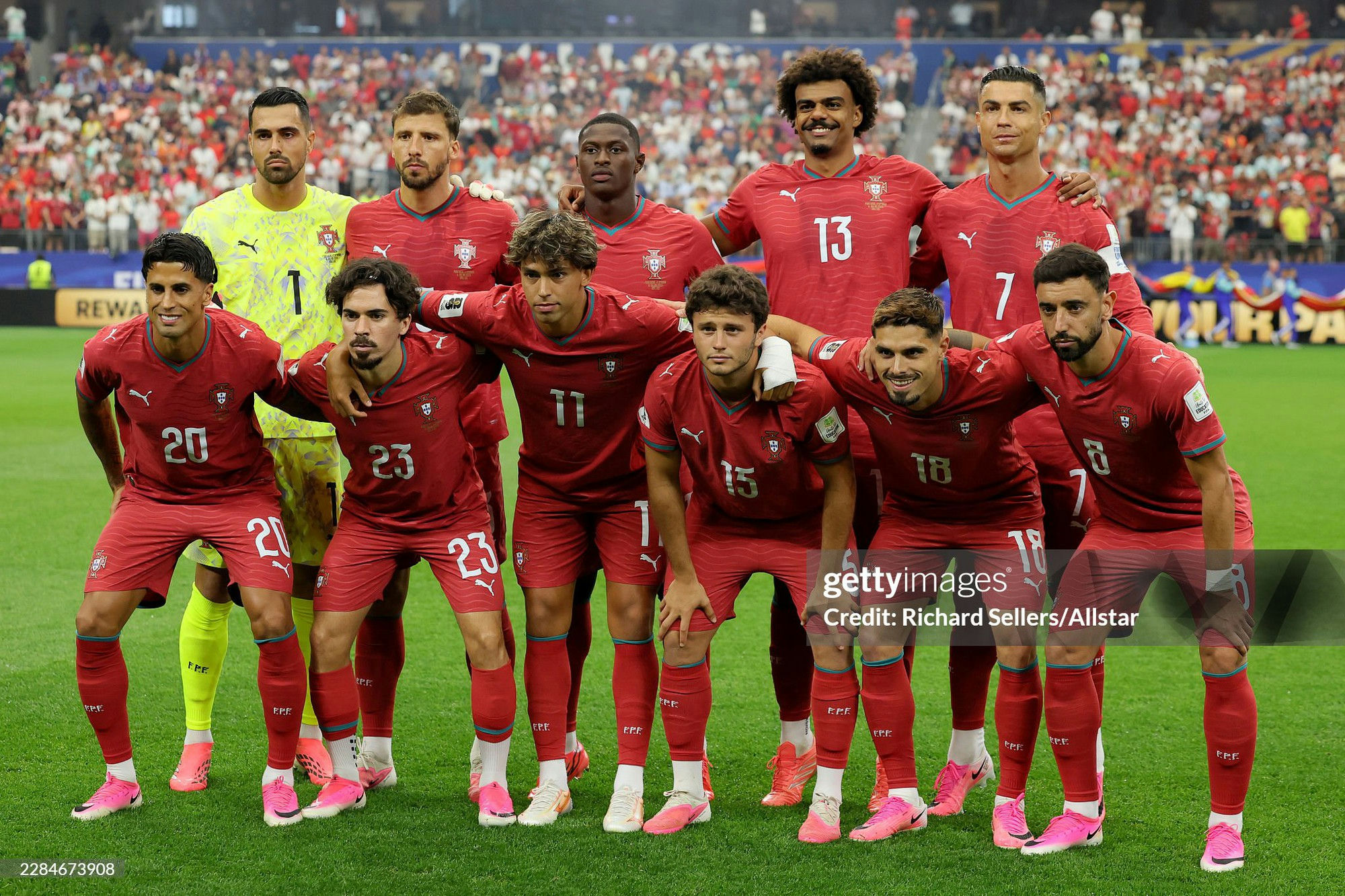
This transformation was not entirely Ronaldo’s doing. Portugal would not have reached their current position without improvements in youth development, the quality of the domestic league, the country’s major clubs, and successive generations of talented players gaining experience at the highest level. Nevertheless, Cristiano Ronaldo was a constant presence throughout almost the entire journey, playing the leading role for much of it.
He was the outstanding young talent who emerged just as veterans such as Figo and Rui Costa were approaching the end of their careers. He was the biggest superstar in a Portugal squad filled with relatively good players who were burdened with enormous expectations simply because they had Cristiano Ronaldo on their side. He was the captain for 19 years, from his early days as a young player until he became a veteran. The irony is that just as Portugal finally assembled a squad filled with outstanding players who were expected to help Ronaldo win his first World Cup, his legs had already begun to grow weary.
Ronaldo has accomplished extraordinary things throughout his career, maintaining an almost extreme level of discipline in his training and diet. But ultimately, even he could not escape the passage of time. His performances at the final two major tournaments of his career, Euro 2024 and the 2026 World Cup, left many fans sighing: “If only Ronaldo were 10 years younger. If only he had these teammates during the peak of his career…”
But as the saying goes, “If wishes were horses, beggars would ride.” Regrets about what might have been are merely fantasies that can never become reality. Still, if someone said those words to Ronaldo, perhaps he would not think about things that never happened. Instead, he would remember a summer night in Paris in 2016.
It was the Euro 2016 final in Paris, where Ronaldo left the pitch in tears after suffering an injury early in the first half following a collision with Dimitri Payet. He went off for treatment and tried to return once, but was unable to continue. He broke down in tears in front of television cameras and hundreds of millions of viewers. The image of Ronaldo crying as a butterfly fluttered in front of him remains one of the most unforgettable memories of Euro 2016. After the darkest moment came the dawn. Later, with his knee bandaged, Ronaldo stood on the touchline, shouting instructions and urging his teammates forward like a second coach.
When Éder scored the decisive goal, Portugal became European champions for the first time, and Ronaldo cried again. These were no longer tears of heartbreak, like those shed 12 years earlier when Portugal lost the Euro 2004 final to Greece on home soil. From a 19-year-old boy crying in defeat to a 31-year-old captain crying in triumph, it was a journey that even Hollywood would struggle to write better.
Ronaldo has won countless honors at club level. Yet he has always considered the Euro 2016 title with Portugal his greatest achievement. For him, representing Portugal was never merely an obligation. It was a source of pride and honor for a boy from a poor hometown who had once been mocked by classmates for his regional accent, before becoming captain of his country and an idol whose influence extended far beyond the football pitch.
When Ronaldo Had to Learn to Let Go
Ronaldo is one of the most fiercely competitive players football has ever seen. His almost extreme desire to win helped him maintain an extraordinary level of performance at the highest level for so many years.
However, the very qualities that took Ronaldo to the top sometimes made it difficult for him to accept change, including the reality that he could no longer always be the most important player on the pitch or a guaranteed starter.
The 2022 World Cup exposed this contradiction, as Portugal produced some impressive performances with Ronaldo on the bench. At Euro 2024, debates continued when he failed to score a single goal, despite the national team having younger and more dynamic attacking options. And after Portugal were eliminated in the Round of 16 at the 2026 World Cup, questions about Ronaldo’s future became increasingly unavoidable.
Perhaps Ronaldo himself understood that a changing of the guard was inevitable. But understanding something and accepting it are two different things, especially for someone who has spent his entire life proving that ordinary limits do not apply to him. In his farewell message, Ronaldo seemed to have finally learned how to let go and accept reality, without trying to paint an otherwise imperfect journey as a fairytale.
He admitted that he had made mistakes, endured pain, and sometimes failed to give the Portuguese people what they had hoped for. But he then affirmed: “…I never gave up. And above all, I never stopped feeling proud to represent Portugal.”
“With time, I have learned a few things: Goals eventually fade. Trophies end up in museums. Records are eventually broken. But there is one thing that time cannot erase: our place in people’s hearts.”
For a player once considered obsessed with statistics and records, this may be one of Ronaldo’s most meaningful reflections. After spending almost his entire career chasing milestones that seemed impossible to surpass, he ultimately acknowledged that even those achievements would one day become part of the past.
On the day he said goodbye to the national team, he also understood that football’s value goes far beyond what is recorded in statistics books: “If I ever made you happy, if one of my goals ever made you hug someone, forget a worry, or feel proud of your country, then it was all worth it. Portugal will always need young people who dare to dream. Players who never give up. New generations who believe they can reach places no one has ever reached before. Because a country that never stops producing new heroes is a country that never stops believing in itself.”
For Ronaldo fans outside Portugal, his farewell may still leave a sense of emptiness. After all, his 23-year journey was followed by millions of people who were not Portuguese but came to love the national team simply because of Cristiano Ronaldo. They were international fans from Asia to Africa, people with no connection to Portugal who were nevertheless willing to wake up in the middle of the night despite time differences, or watch football during working hours, just to support the team wearing Ronaldo’s shirt.
The author of this article was among those fans, having visited Ronaldo’s hometown of Madeira in 2017, including the place where he was born and the Cristiano Ronaldo Museum, to pay tribute to the player who inspired so much determination and created unforgettable emotions on the football pitch.
Football will eventually find new idols. Portugal will produce new football heroes, just as Ronaldo hopes. But for those who love him, Cristiano Ronaldo will always be one of a kind — unique and irreplaceable.
Sources: kenh14