



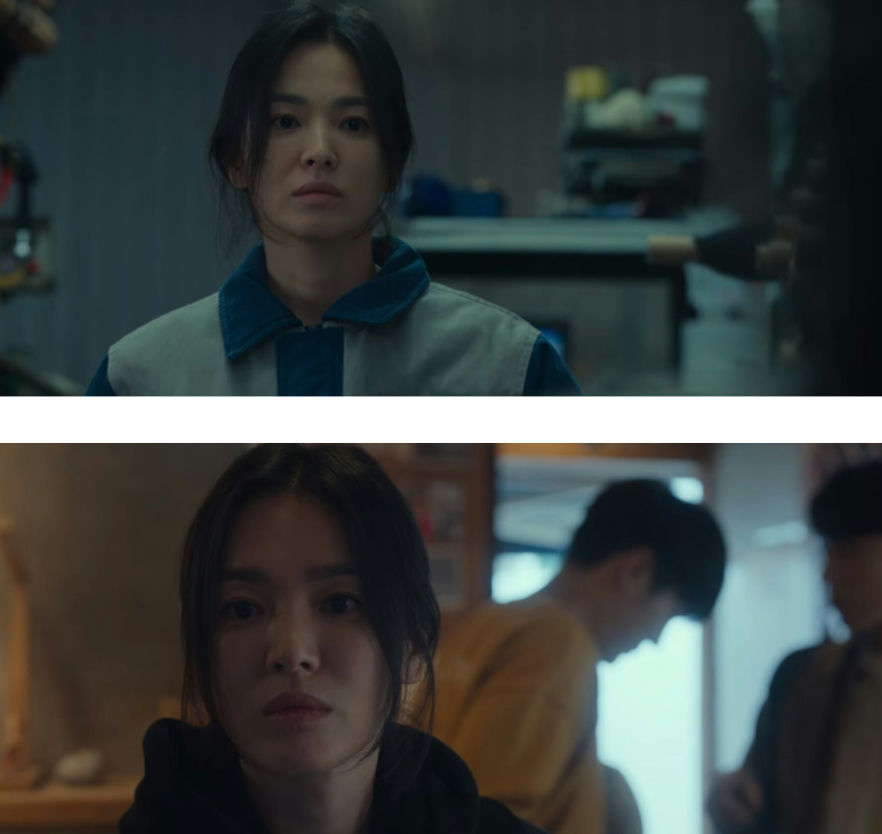
In recent years, viewers have become far less forgiving of what is often called “playing young” casting, when actors in their 30s or 40s portray teenage or early-20s versions of their characters.
When “Playing Young” Breaks Immersion

In The Glory, Song Hye Kyo initially benefited from strong casting choices during the high school timeline, where younger actors delivered a highly praised and emotionally grounded performance.
However, when the story transitioned to the character’s early 20s, the role reverted to Song Hye Kyo herself, then in her 40s, creating a noticeable disconnect for some viewers. The shift disrupted narrative continuity, raising questions about why the production did not continue using younger actors for a timeline only a few years later.
A similar controversy has emerged with Perfect Crown, where IU (32) and Noh Sang Hyun (35) appear in school uniforms in teaser footage. While IU’s youthful visuals still feel somewhat believable to some audiences, reactions toward Noh Sang Hyun have been more critical, with many viewers describing the casting as unrealistic and distracting.

The backlash reflects a broader shift in audience expectations, where visual authenticity is increasingly valued over star power.

A Repeated Industry Pattern
This is far from an isolated issue. Actors like Song Joong Ki in Reborn Rich, Son Ye Jin in Thirty-Nine, and Park Min Young in multiple dramas have all portrayed significantly younger versions of their characters, often relying on filters or styling rather than casting alternatives.

While these decisions may seem practical, they often come at the cost of realism. Behind this trend lies a mix of convenience and risk aversion. Casting younger actors requires time, effort, and uncertainty, especially when those roles carry emotional weight in early episodes.
Using established stars ensures immediate audience engagement and marketing appeal, particularly during crucial opening scenes. However, this strategy increasingly clashes with viewer expectations for believable storytelling.

Not Always Wrong, But Overused
To be fair, having the same actor portray a character across timelines can maintain emotional continuity, especially in psychologically driven narratives. It also reduces the risk of inconsistent performances. However, the issue arises when this approach is overused or applied without nuance—especially when the age gap becomes too noticeable or when better casting options are available.

Ultimately, the growing criticism signals a shift in what audiences prioritize. Rather than simply seeing their favorite stars on screen, viewers now demand credibility and immersion.
From Song Hye Kyo to IU, the conversation is no longer about talent but about whether the storytelling choices serve the narrative. And increasingly, audiences are making it clear: they want stories they can believe in, not just faces they recognize.