



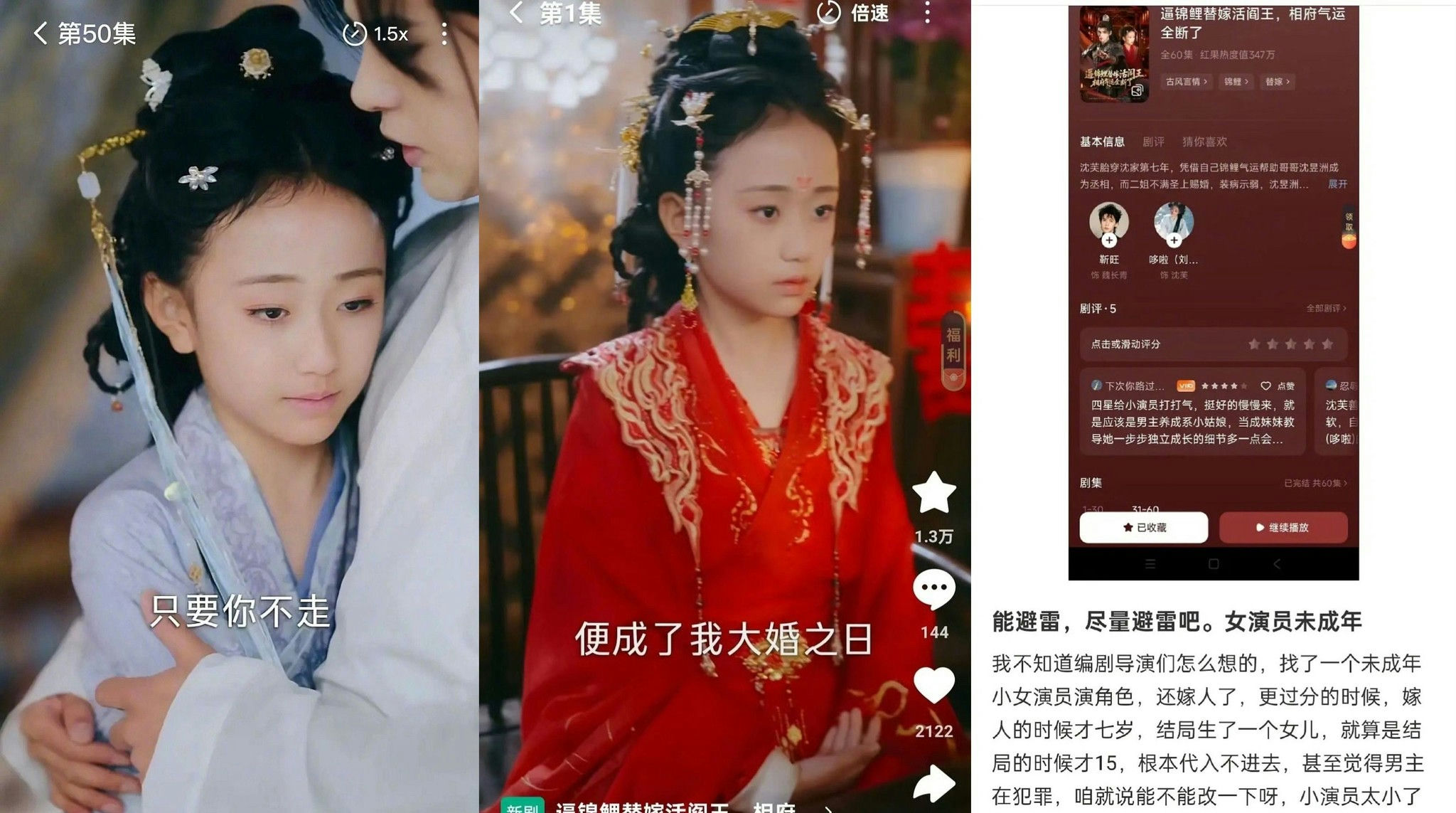
A Chinese short-form drama has ignited widespread outrage after its release on Douyin, with viewers condemning its storyline centered on the forced marriage of a seven-year-old girl. The series, titled Forcing the “Lucky Carp” to Marry the “Living King of Hell”, Leaving the Prime Minister’s Mansion Completely Devoid of Fortune, has quickly become one of the most controversial short-form dramas currently circulating online in China.
The 80-episode drama follows a young girl of low status living in a powerful household, believed to be a “lucky carp” blessed with extraordinary fortune. Rather than protecting her, the family exploits her perceived luck and forces her to marry in place of another woman to a notorious general known for his cruelty and cold demeanor, ominously nicknamed the “Living King of Hell.”

What initially appears to be a marriage sentence leading to death gradually shifts as the girl’s presence begins to change everything. The general’s misfortune mysteriously fades, the female lead’s true identity and abilities are slowly revealed, and those who once oppressed and drained her luck face retribution, with their household collapsing and their fortune running dry.
The core of the public backlash lies in the age of the female lead. The character is explicitly portrayed as only seven years old, yet the drama includes romantic elements and even kissing scenes with her male co-star. In real life, actress Liu Xingchen, who plays the lead role, is just ten years old and acts opposite Jin Wang, who is reportedly 18 years older than her.
Social media platforms have been flooded with criticism, with many users accusing the series of promoting disturbing, inappropriate, and morally warped content. Calls to boycott the drama and demands for its removal from streaming platforms have grown louder, with viewers urging authorities to intervene. Despite the intense backlash, the series remains available on multiple platforms and continues to rack up high view counts.
In recent years, short-form dramas have exploded in popularity across China thanks to their easy accessibility, fast pacing, and wide distribution on platforms like Douyin. However, the low production threshold often marked by rushed scripts, weak acting, and careless post-production has led to a surge of low-quality and controversial content. This case has become a stark example of how the unchecked growth of short-form dramas can cross ethical lines, reigniting debates about regulation, child protection, and responsibility in China’s digital entertainment industry.
Sources: Znews