



A recent report by the Korean Film Council (KOFIC) has sparked widespread discussion online, revealing that actor salaries now account for a significant portion of the total production costs in commercial Korean films.
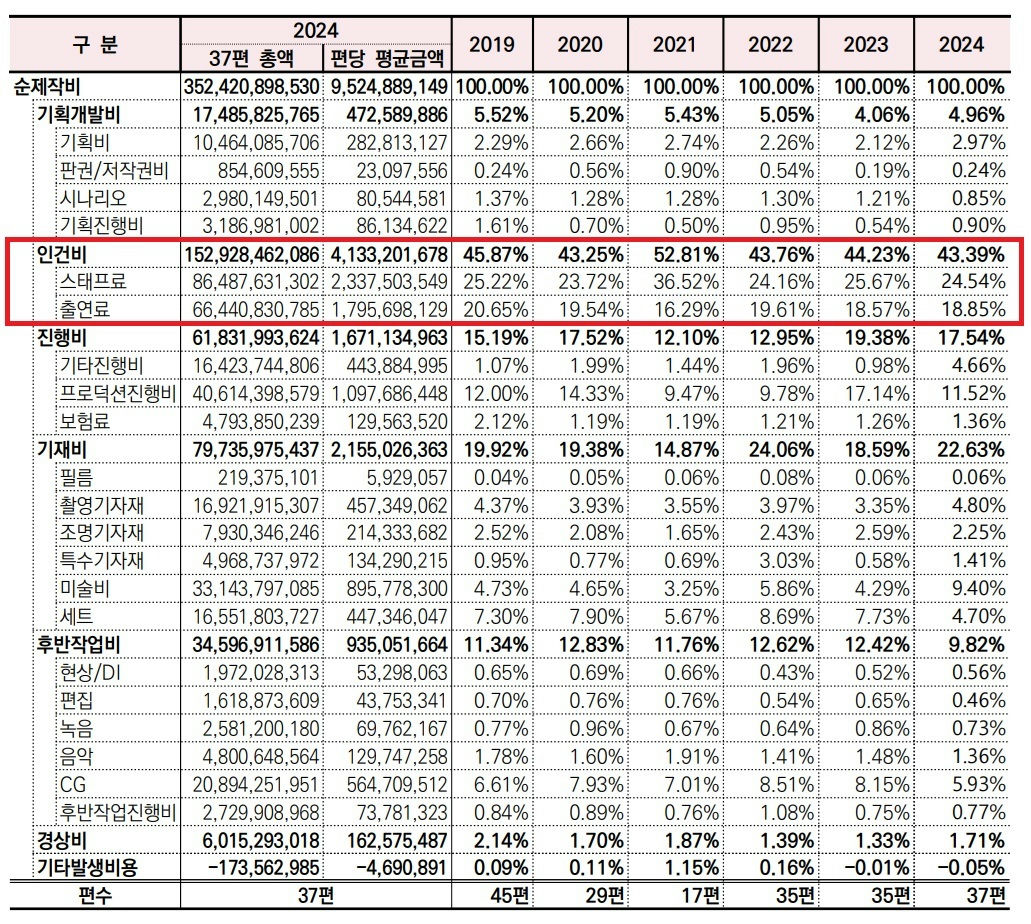
According to the report, the average production cost of a commercial Korean film in 2024 is approximately 9.5 billion KRW (about 6.56 million USD). Of this, labor expenses represent 43% of the budget, or around 4.1 billion KRW. Notably, actors’ fees alone make up 1.8 billion KRW (1.24 million USD), nearly half of the labor costs, with the rest allocated to crew salaries.
As the Korean film market continues to shrink in the aftermath of the COVID-19 pandemic, the high proportion of actor fees has become a focal point in discussions around sustainable production models. While actor salaries temporarily dipped following the pandemic, KOFIC’s data shows the percentage has stabilized at around 18–19% of total production costs.

Industry analysts note that this reflects the Korean film industry’s heavy reliance on star-driven projects. Hiring A-list actors is often seen as a way to boost box office appeal, but this strategy also increases financial risks if the film fails to attract audiences.
Though cutting actor fees could help ease budget pressures, it’s not an easy fix. Industry insiders say the market value of top stars remains firm due to intense competition among production companies. Reducing actor fees could make it difficult to secure bankable talent.
Meanwhile, salaries for production crews are often tied to labor conditions, making it even harder to reduce overall labor expenses.
The structure of the Korean film market only intensifies this issue. In 2024, 68% of the total revenue from 37 commercial films came from box office sales, while streaming platforms contributed a mere 3%. This highlights the industry’s continued dependence on theatrical releases.
With rising production costs, falling ticket prices, and slow growth in digital markets, maintaining profitability is becoming increasingly difficult. As a result, many members of the Korean public have begun to criticize actors for continuing to receive high pay even when films flop.
Some viewers have expressed frustration, arguing that Korean actors are earning salaries comparable to Hollywood stars without delivering box office success. There is growing public support for performance-based pay models to better align actor compensation with a film’s actual results.
Sources: LD