



According to 163, 2025 marked a powerful comeback year for Zhao Lusi. Once plagued by health issues, contract disputes with her management agency, and labeled a “risk factor” for production teams, she made a stunning turnaround with a drama that averaged more than 63 million views per episode. Love’s Ambition became the most-watched series on Tencent Video in 2025 and even topped viewership rankings across all major platforms, including Youku, iQIYI, and Mango TV.
Thanks to the drama’s overwhelming success, Zhao Lusi took center stage at the Tencent Video Starlight Awards, appearing last on the red carpet a position widely regarded as the highest honor of the evening. This placement signaled the platform’s strong endorsement of her status, influence, and commercial value among dozens of attending celebrities. She also received the award for “Influential Artist of the Year,” further cementing her dominant presence.

However, Tencent Video’s clear favoritism toward Zhao Lusi quickly ignited controversy. Many questioned whether she truly deserved such treatment. According to 163, the 2025 Starlight Awards featured veteran, highly respected artists such as Song Jia, Wang Baoqiang, and Ni Ni. Despite their seniority and acclaimed careers, Zhao Lusi – a 98-liner with comparatively limited experience was chosen as the event’s focal point. Critics argued that her professional seniority and artistic depth did not match the level of honor she received, and that positioning her as the “central figure” diminished the prestige of the ceremony itself.

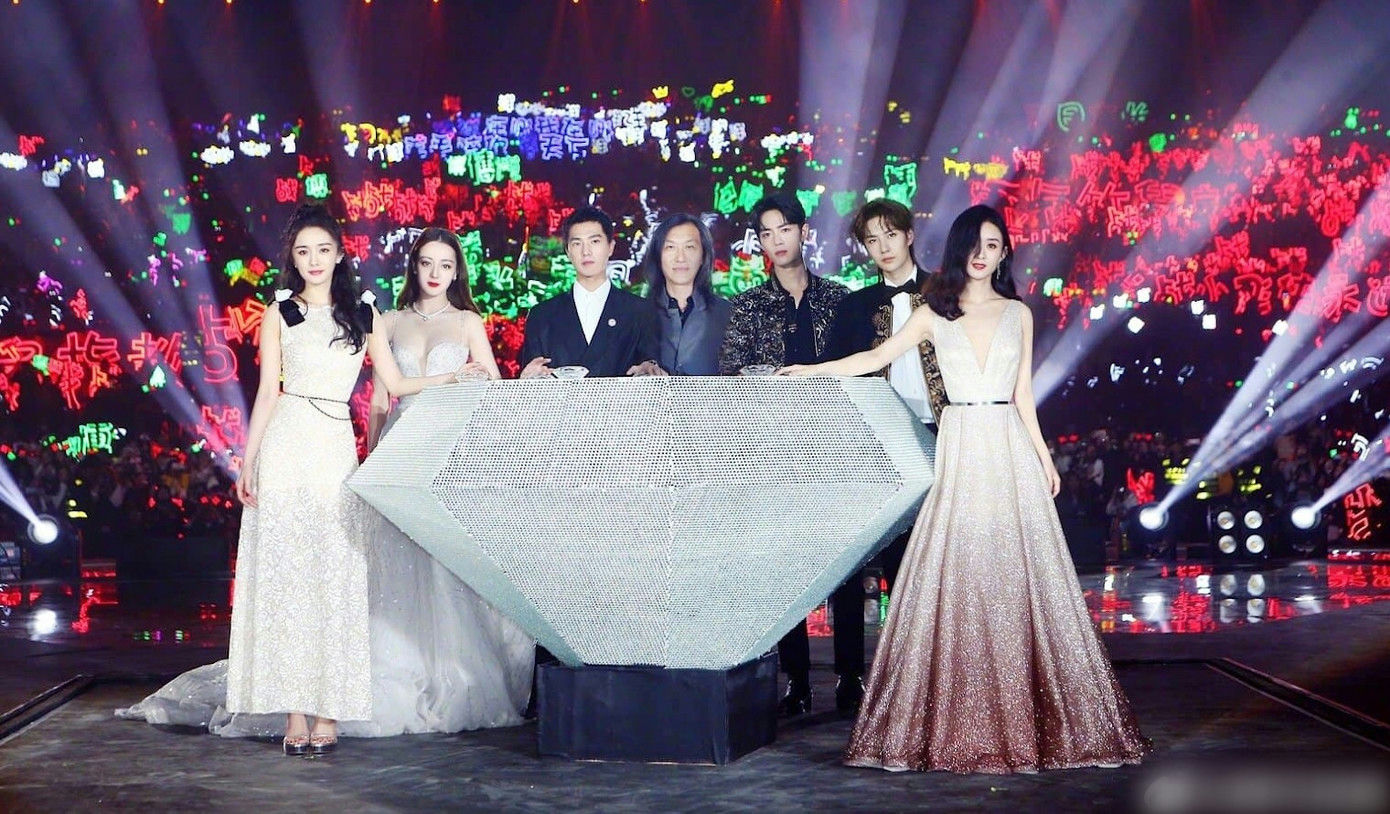
Adding fuel to the criticism, the 2025 Starlight Awards were widely described as lacking scale, excitement, and star power compared to previous years. Many viewers nostalgically recalled earlier editions from 2019 and 2020, when industry heavyweights such as Yang Mi, Zhao Liying, Dilraba Dilmurat, Yang Yang, Xiao Zhan, Wang Yibo, and Yang Zi dominated the guest list. Those years were remembered as a “battle of the gods,” symbolizing Tencent Video’s industry influence and the golden era of Chinese entertainment.
By contrast, the 2025 lineup for “VIP Stars of the Year” included names such as Gong Jun, Liu Yuning, Tan Jianci, Chen Duling, Meng Ziyi, Li Yunrui, Song Zu’er and Ding Yuxi. Like Zhao Lusi, many of these artists were criticized for lacking truly iconic roles, long-term achievements, or industry-defining influence. Their presence led some viewers to lament the disappearance of top-tier stars and question whether both the Starlight Awards and the broader Chinese entertainment industry were losing their luster.

Yet 163 offers a different interpretation, framing the situation as a reflection of a pragmatic and evolving industry. Tencent Video’s support of younger stars highlights a generational shift in C-entertainment. The era dominated by the post-85 actresses is fading, with film and television resources increasingly flowing to artists born after 1995 and 2000 performers shaped by the digital age. In today’s landscape, an actor’s status is no longer determined solely by seniority or artistic prestige, but also by measurable traffic, data, and profitability.
From this perspective, Tencent Video’s choices are driven by results. In 2025, Zhao Lusi delivered top-tier performance metrics for the platform, ranking first in popularity and viewership. As such, she embodied the values Tencent Video prioritizes: attention, engagement, and commercial success. The same logic applies to stars like Chen Duling, Song Zu’er, and Liu Yuning, who also brought tangible returns.

This dynamic underscores a clear divide between platform-driven events and professional award ceremonies one emphasizes traffic and market performance, while the other prioritizes acting skill and artistic merit. Seen through this lens, Zhao Lusi’s central role at the Starlight Awards is not evidence of a talent vacuum or industry collapse, but rather a straightforward reflection of value-based decision-making.
While Zhao Lusi remains a polarizing figure, as long as she continues to generate strong results and her projects resonate with audiences, platforms will continue to favor her. This, ultimately, is the reality of today’s highly pragmatic Chinese entertainment industry.
Sources: K14