



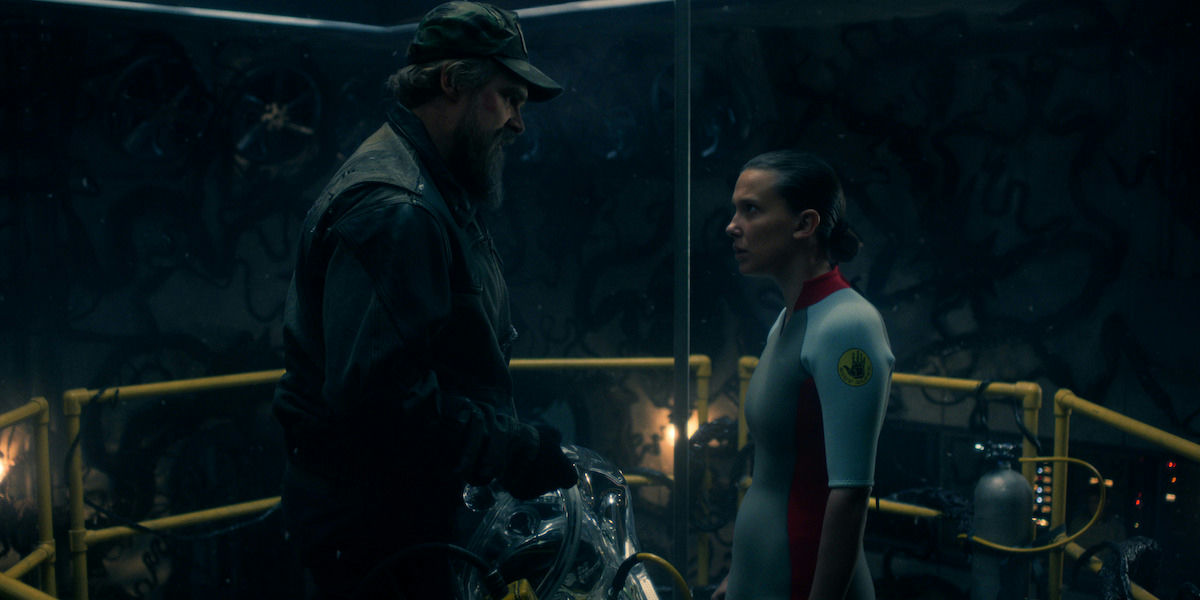
Regardless of how its ending is judged, Stranger Things remains one of the most defining television series of the past decade and Season 5 stands as its emotional conclusion. The final season of Netflix’s flagship series premiered in stages starting in late November: the first four episodes released initially, followed by three episodes over Christmas, and the final episode airing on the morning of January 1, 2026. Created once again by the Duffer Brothers, with additional directors contributing, the season balances blockbuster spectacle with a strong emotional core befitting a farewell.
A Heavier, More Mature Return to Hawkins
Stranger Things Season 5 does not simply continue the story; it signals a clear shift toward darker, more mature storytelling compared to the youthful adventure tone of earlier seasons. From the opening episodes, the introduction of new characters previously teased through posters feels purposeful rather than cosmetic. Most notably, Holly Wheeler becomes Vecna’s next target, pulling the group into a new and dangerous spiral that reshapes the entire narrative.

The mission to save Holly functions as more than a survival quest. It becomes the catalyst for deeper character exploration: Will, once the perpetually missing boy on the sidelines, steps decisively into the center of the story; Eleven is no longer framed solely as an all-powerful savior; and long-standing relationships like Nancy and Jonathan’s are finally forced to confront questions about their future instead of avoiding them.
Hawkins itself undergoes a transformation. The nostalgic 1980s town of bike rides and youthful escapades gives way to a setting scarred both physically and emotionally, as the boundary between the real world and the Upside Down continues to erode. Rather than leaning heavily on horror, the season devotes more time to examining the psychological toll of years spent facing supernatural evil.
A Strong Opening and a Bold Narrative Shift
The first four episodes serve as an impressive opening act. The Duffer Brothers move away from positioning Eleven as the sole focal point and deliver a major turning point: Will’s revelation of his own formidable abilities. His climactic moment at the end of Episode 4 when he confronts the hive-like force and saves the others at the last second stands out as one of the most cinematic sequences in the entire series. This twist fundamentally alters the trajectory of the season and opens the door to a grander, more collective approach to the final battle.

Supporting characters are also given unexpected depth. Karen Wheeler emerges as more than a background parent figure, repeatedly appearing at moments of crisis and offering insight into why the Wheeler children are so courageous. Meanwhile, new character Derek adds a welcome dose of humor through his natural, endearing personality, helping balance the season’s increasingly heavy atmosphere.
Slower Middle Episodes and Divided Reactions
The three episodes released over Christmas sparked mixed reactions. Instead of accelerating toward a confrontation with Vecna, the story lingers on the characters’ internal struggles. This choice slows the pacing and, for some viewers, drains momentum. Some moments were criticized for lacking emotional subtlety and feeling underdeveloped compared to similar storylines handled more delicately in other series.

Yet when viewed as part of a closing journey rather than a constant escalation, these quieter moments serve a purpose. They force the characters to confront their deepest fears and unresolved truths. Only by doing so can they face Vecna not just with strength, but with genuine maturity an idea Stranger Things has been building toward for nearly a decade.
A Finale Designed for Longtime Fans
The final episode chooses resolution over shock value. Instead of introducing last-minute twists, it brings the characters together on a single front and reflects on everything they have endured since the beginning. The familiar structure each character playing a specific role within a shared plan reinforces the teamwork that has always been the heart of the series, while also allowing each individual arc to reach completion.

With a runtime approaching two hours, the finale maintains a brisk but controlled pace. Every action is grounded in narrative threads established in earlier seasons, making the outcome feel earned rather than forced. The emotional peak arrives when all the familiar pieces finally align in a sequence that is both visually grand and emotionally heavy. Each character fights not only for Hawkins, but for the memories and losses that shaped who they have become.
The episode also takes time to honor those who contributed to the journey across seasons. Rather than indulging in overt sentimentality, it offers a quiet tribute an acknowledgment of sacrifice that resonates deeply with long-term viewers.
A Generational Emotional Milestone
For fans who have followed Stranger Things since its debut, Season 5 delivers a sense of closure that feels fair and complete. After years of trauma and fear, the characters are finally given the chance to look toward a future beyond survival. The final moments echo the innocence of the series’ early days, forming a hopeful loop that reinforces what Stranger Things has always been about: friendship, youth, and growing up together in an ordinary world hiding extraordinary dangers.

While not flawless, Stranger Things 5 succeeds where it matters most. It is emotionally rich, structurally confident, and deeply sincere in its goodbye. Few series manage to make audiences feel as though they have grown alongside the characters themselves. For many, Stranger Things was never just entertainment it was an emotional marker of youth. And it may be a long time before another series leaves a similar imprint on an entire generation.
Sources: K14