



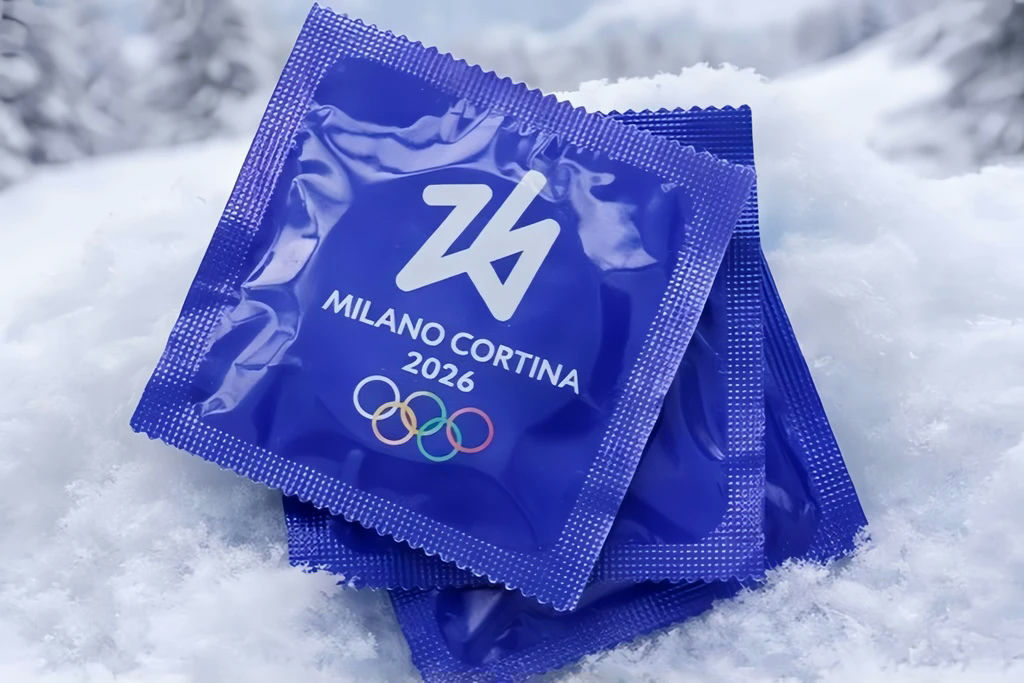
According to the Italian daily La Stampa, the initial supply prepared for athletes was fully distributed within 72 hours. Approximately 3,000 athletes are currently competing in Italy. Lombardy Governor Attilio Fontana addressed the situation by reminding athletes, “Health comes first: take precautions and act responsibly.”
But does the figure indicate a spike in sexual activity — or simply limited supply?
Is the Number Misleading?
The distribution of free condoms at the Olympic Village dates back to the late 1980s, when organizers began providing them during the Olympic Games to raise awareness about HIV/AIDS prevention and sexually transmitted infections.

Since then, condoms have been part of the Olympic health program — not as encouragement of sexual behavior, but as a public health measure promoting safe practices. Historically, the number of condoms provided varies significantly depending on the scale of the Games:
- At the Rio 2016 Summer Olympics, approximately 450,000 condoms were distributed to over 10,000 athletes — a record high.
- During the PyeongChang 2018 Winter Olympics, around 110,000 condoms were supplied, averaging more than 30 per athlete — the highest figure in Winter Olympic history.
- At the Paris 2024 Summer Olympics, organizers continued the policy with 300,000 condoms for roughly 10,000 athletes, or about 30 per person.
Compared to these precedents, 10,000 condoms for 3,000 athletes in Milan-Cortina 2026 appears relatively modest. In that context, the rapid depletion may reflect limited initial stock rather than extraordinary behavior. Adding nuance, some athletes at PyeongChang 2018 reportedly collected condoms as souvenirs because the packaging featured official Olympic branding, according to Yonhap News.
An anonymous athlete told La Stampa, “The supply ran out in three days. They promised to restock, but we don’t know when.” Spanish figure skater Olivia Smart also shared a video from inside the Village showcasing limited-edition condom packages featuring the yellow Lombardy logo, saying, “I found them. They have everything you need.”
The “Steamy” Reputation of the Olympic Village

Beyond medals and records, each Olympic edition reignites curiosity about life inside the Olympic Village. The image of thousands of young, elite athletes from around the world living together in a confined environment for weeks has long fueled the perception of a “high-energy” atmosphere.
Over the years, several athletes have openly discussed intimate encounters during the Games. In 2012, U.S. soccer player Hope Solo told ESPN there was “a lot of sex going on.” American shooter Josh Lakatos once said he had “never seen so much debauchery,” while swimmer Ryan Lochte estimated that 70–75% of Olympians engaged in intimate activities.
Media coverage has further amplified the narrative. GQ has referenced long-standing Olympic Village anecdotes, while the Daily Mirror reported that the dating app Grindr experienced server overload during the London 2012 Summer Olympics.
However, experts caution against overgeneralization. Dr. Kelly Campbell of California State University, San Bernardino, notes that the Olympic environment brings together similarly aged, physically fit individuals in an emotionally heightened, competitive setting — factors that can foster connection.

At the same time, many athletes emphasize that competition remains their primary focus. Some attend with partners or maintain long-term relationships. U.S. climber Kyra Condie once remarked that the Village “is not as wild as people imagine,” while a multi-time Paralympic swimmer noted that media narratives often exaggerate reality.
More About Perception Than Proof
The free condom program itself frequently attracts media attention. Whenever distribution numbers are announced, they are often interpreted as indicators of athletes’ private lives — even though the initiative’s purpose is rooted in public health.
Ultimately, the fascination may stem from the gap between the athletes’ public image and their private world. Spectators see only peak performance moments. The unseen personal side becomes fertile ground for speculation. Viewed in context, the 10,000 condoms at Milan-Cortina 2026 likely say more about logistics than lifestyle — and more about public curiosity than athlete behavior.
Sources: Znews